Internet
The global network infrastructure that lets computers exchange information. Its foundations predate websites by decades.
THE INTERNET, THE WEB & WHAT CAME NEXT
A visual textbook about the ideas, inventions, businesses, and everyday habits that carried us from room-sized networks to websites that can help build themselves.
Computers learned to communicate across distance. The Internet's foundations formed, but there were no web pages or browsers yet.
Open this chapter ↘Conceptual 3D model · chapter dates and sources belowTHE DISTINCTION THAT MAKES THE TIMELINE CLICK
The global network infrastructure that lets computers exchange information. Its foundations predate websites by decades.
A system of linked documents, addresses, and browsers built on top of the Internet, proposed in 1989.
A connected collection of pages at an address. Over time, websites evolved from documents into media, stores, communities, and software.
A top-level domain originally created for commercial organizations. The first registered second-level .com arrived before the Web.
COURSE MAP
1969–1984
The first chapter is about connection, not pages. Researchers were learning how distant computers could exchange small pieces of data reliably.

ARPANET’s first node was installed at UCLA in September 1969. Packet switching broke messages into pieces that could travel independently. Email appeared on networked systems in the early 1970s, and TCP/IP became ARPANET’s standard in 1983.
Almost nobody “went online” from home. Networking belonged mostly to universities, government, and research institutions. Interactions were typed, specialized, and largely invisible to the public.
Terminals, command lines, printed logs, blinking hardware, and maps of connected institutions—not clickable pages, photographs, or navigation bars.
1969 First ARPANET node
1972 Network email demonstrated
1983 TCP/IP transition
1984 Domain Name System expands
The Internet and the Web are often treated as synonyms, but they are not the same invention. The Internet is the network of networks—the underlying roads. The World Wide Web, created later, is a way to publish and navigate linked documents using those roads.
The Domain Name System made the network easier to use by translating memorable names into numerical addresses. That step created the naming layer on which addresses such as thewebpagedotcom.com would eventually live.
Primary reading: Internet Society, A Brief History of the Internet ↗
CARRY FORWARD First came the network. Human-friendly pages came later.
1985–1988
.com arrives before the Web.A useful surprise: the first .com domain and AOL’s consumer-service roots both predate Tim Berners-Lee’s Web proposal.
symbolics.com was registered on March 15, 1985, becoming the first second-level .com domain. Domain names were still scarce and mostly institutional.
Online services offered curated areas for messaging, news, games, and files. AOL’s predecessor launched a Commodore 64 service in 1985. Users entered a service, rather than freely browsing an open Web.
Text menus, modem connections, proprietary software, and closed collections of content. The familiar visual browser still did not exist.
1985 First .com registered
1985 AOL predecessor’s consumer service
1986 NSFNET grows academic access
1988 Networked communities expand
The “dot-com era” is usually associated with the late 1990s, but its naming system began a decade earlier. A domain gave an organization a durable identity on a growing network. That idea would become foundational to online trust, branding, and commerce.
Consumer online services were easier than the open Internet but operated like walled gardens. They introduced ordinary households to email, chat, forums, and downloadable content—habits the open Web would later absorb.
Primary reading: ICANN on the first .com ↗ · AOL history ↗
CARRY FORWARD The address and the audience were forming before the page.
1989–1994
Tim Berners-Lee combined addresses, linked documents, and a transfer protocol into a system that made information navigable.

Berners-Lee proposed the Web at CERN in March 1989. By the end of 1990, the essential pieces—HTML, HTTP, URLs, a server, and a browser/editor—were working together.
NCSA Mosaic’s 1993 release made graphical browsing approachable. Yahoo began in 1994 as a human-organized guide to a Web that was already becoming difficult to map.
Plain backgrounds, blue underlined links, small inline images, lists, and documents. A website behaved more like a connected reference shelf than a modern application.
1989 Web proposal at CERN
1990 First browser and server
1993 CERN releases Web software publicly
1994 Yahoo begins as a directory
The breakthrough was not a single screen design. It was a set of open conventions. A URL identified a resource, HTTP moved it, HTML described it, and a browser made it navigable. Because the pieces were openly implementable, the Web could spread beyond one company or institution.
On April 30, 1993, CERN put core Web software into the public domain. NCSA Mosaic then demonstrated how pictures and text could coexist in an accessible graphical browser. Publishing and exploring information suddenly became much more intuitive.
Primary reading: CERN, The birth of the Web ↗ · NCSA Mosaic ↗ · Yahoo story ↗
CARRY FORWARD Open standards let anyone become a publisher—and every page become a doorway.
1995–1999
The Web left the laboratory and entered the family room. Discovery, identity, shopping, and speculation moved onto the same screen.
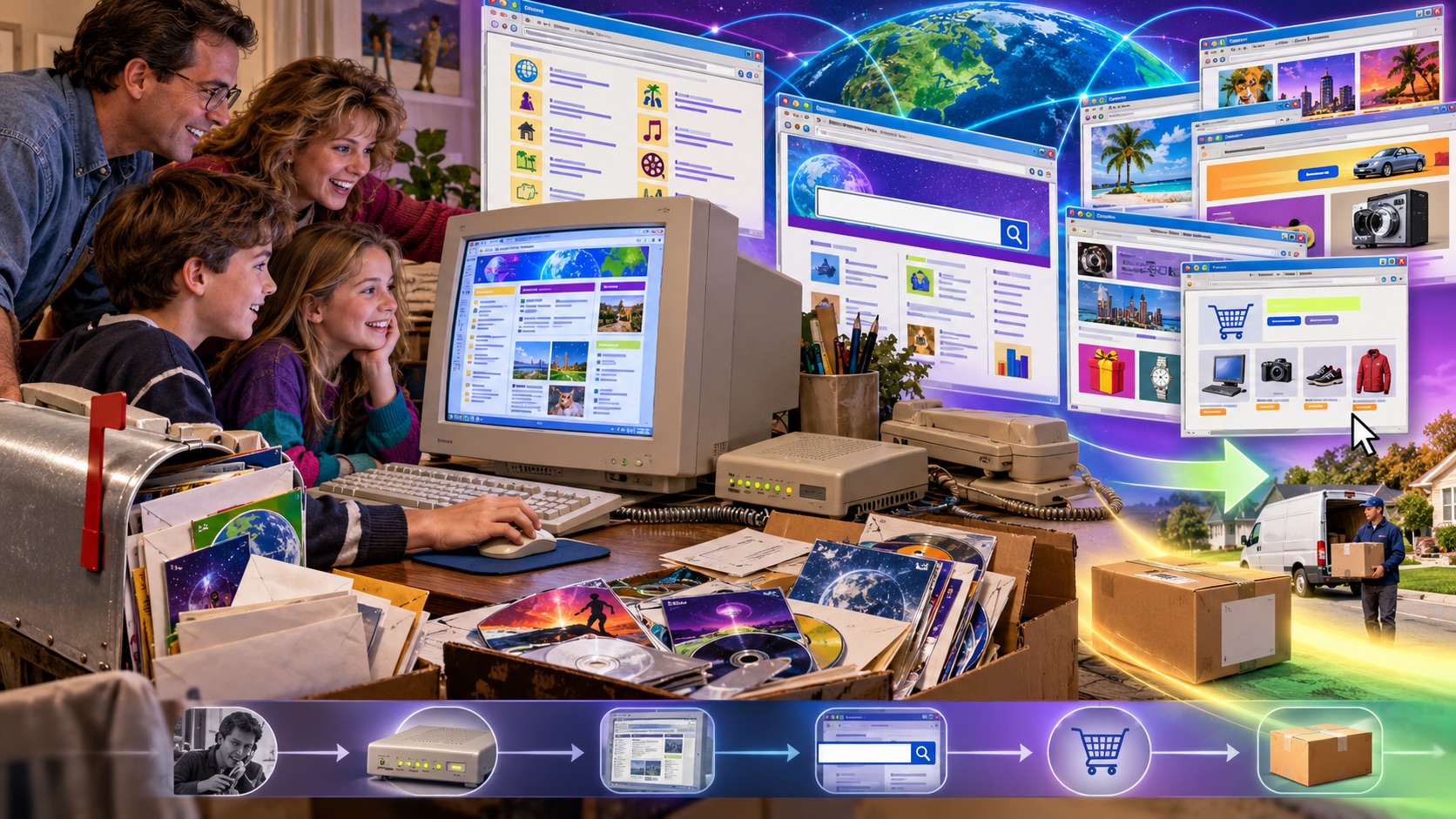
Commercial traffic grew after the NSFNET backbone transition in 1995. Browsers competed, JavaScript arrived, and websites began responding to users instead of only displaying documents.
Trial discs and dial-up modems brought millions online. Yahoo offered a starting point; AOL blended email, chat, and access; Google incorporated in 1998 around a new approach to search.
Portal columns, visitor counters, animated GIFs, tiled backgrounds, banner ads, frames, “under construction” signs, and navigation designed for 640-pixel screens.
1995 Commercial Web accelerates
1995 Yahoo.com registered
1995 JavaScript debuts
1998 Google incorporates
This was the first period in which “going online” became a common household activity. The modem occupied the telephone line, pages assembled slowly, and directories or portals served as home bases. The constraints were frustrating, but the ability to reach people and information elsewhere felt extraordinary.
Businesses rushed to claim domains and experiment with commerce. The resulting dot-com investment boom funded genuine infrastructure and genuine excess. The Web was becoming an economy as well as a medium.
Primary reading: AOL history ↗ · Yahoo story ↗ · Google’s early years ↗
CARRY FORWARD The Web changed from a library into a marketplace, meeting place, and daily habit.
2000–2004
Market enthusiasm collapsed, but the network did not. Better infrastructure and participatory publishing laid the groundwork for the next wave.

Broadband expanded, CSS matured, content-management tools improved, and standards advocates pushed designers away from browser-specific hacks toward more structured pages.
Blogs made publishing routine. Wikipedia showed that a shared reference work could be assembled in public. Search became the normal front door to a rapidly expanding Web.
Cleaner layouts, smaller header graphics, blog sidebars, date-stamped posts, comment forms, and the orange RSS icon. Pages began to feel regularly updated rather than permanently “published.”
2000 Dot-com correction begins
2001 Wikipedia launches
2003 WordPress launches
2004 Participatory Web accelerates
The dot-com crash is not the end of the Internet story; it is a filtering event inside it. Companies without workable economics disappeared, while the underlying infrastructure, skills, and audience remained. The Web’s next phase focused less on merely having a site and more on what people could do there.
“Web 2.0” became a popular label for services built around participation: writing, tagging, commenting, collaborating, and sharing. The term was imperfect, but it captured a real change in the role of the visitor—from reader to contributor.
CARRY FORWARD The durable value was not hype. It was participation.
2005–2009
Faster connections made streaming practical. Social feeds reorganized attention. The smartphone put a real browser into a pocket.
AJAX techniques made pages update without complete reloads. Faster connections supported richer video and maps. Browsers grew more capable, while the 2007 iPhone joined phone, media player, and Internet communicator.
Uploading, streaming, sharing, and posting became everyday verbs. Social networks shifted discovery from directories and search results toward feeds and recommendations.
Glossy buttons, gradients, rounded panels, video players, profile pages, badges, maps, star ratings, and increasingly dense interactive interfaces.
2005 Online video breaks out
2006 Social feeds expand
2007 iPhone introduced
2008 Modern browser competition grows
The original Web assumed a page would be requested, downloaded, and read. Mid-2000s services behaved more like running software. Data could refresh in place, maps could move under a cursor, and media could play inside a page.
Apple introduced the iPhone in January 2007 as a phone, iPod, and Internet communications device with a desktop-class browser. It did not create the mobile Web by itself, but it made full-page browsing on a handheld device a mass-market expectation.
Primary reading: Apple’s original iPhone announcement ↗
CARRY FORWARD A website was no longer a place you visited occasionally. It became an environment you carried.
2010–2014
Designers could no longer assume a desktop monitor, a mouse, or even a fast connection. Pages had to adapt.
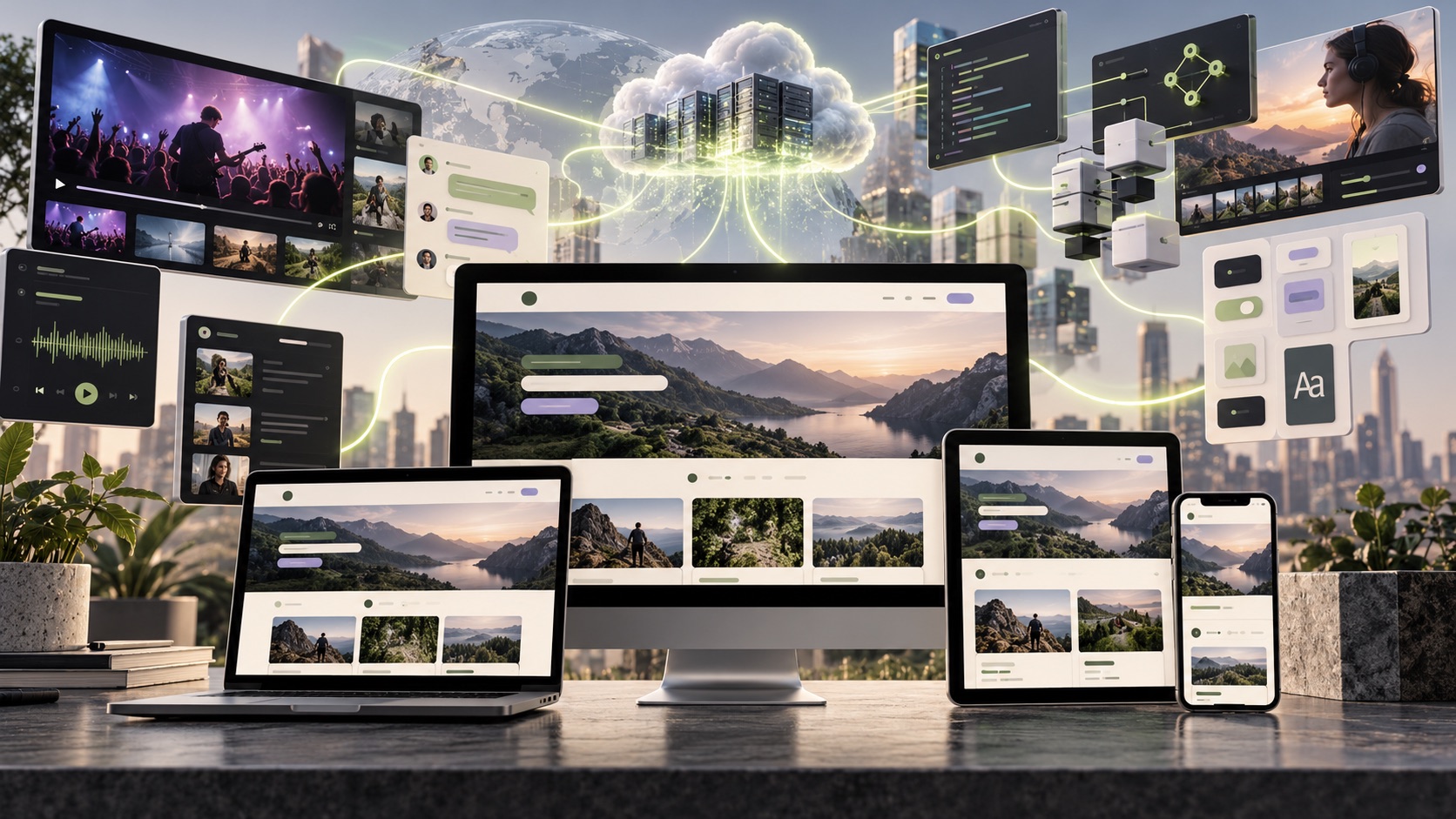
Responsive design used flexible grids, images, and media queries to reshape one page across devices. HTML5 standardized native audio, video, graphics, and richer application features.
Touch gestures, mobile maps, instant photos, notifications, and apps changed expectations. A difficult mobile site became a business liability rather than a minor inconvenience.
Large photography, flat icons, card layouts, hamburger menus, generous touch targets, single-column mobile layouts, and less ornamental chrome.
2010 Responsive design is articulated
2011 Mobile usage accelerates
2012 Retina-density design spreads
2014 HTML5 becomes a W3C Recommendation
Responsive design was more than a visual trick. It was an admission that the Web’s great strength is its ability to flow into many contexts. Designers began treating layouts as systems of rules rather than fixed pictures.
HTML5’s 2014 Recommendation gave the open platform native capabilities that once depended on plug-ins. Video, audio, canvas graphics, and semantic elements improved what a standards-based website could do.
Primary reading: W3C, HTML5 Recommendation ↗
CARRY FORWARD The page became a set of adaptive rules, not a fixed rectangle.
2015–2019
The visible interface was now only one layer. Behind it sat cloud services, APIs, analytics, payments, content systems, and reusable components.
Cloud hosting scaled on demand. APIs joined specialized services. Component-based frameworks changed front-end development, and HTTPS became the normal expectation rather than an optional upgrade.
Banking, work, entertainment, shopping, and communication converged into always-available services. Accounts and data followed users across devices.
Design systems, product dashboards, polished onboarding, modular cards, bold type, motion, and consistent interfaces across large families of pages.
2015 Component-driven apps spread
2016 Conversational interfaces grow
2018 HTTPS becomes the norm
2019 No-code tools broaden creation
A modern site could be assembled from a payment provider, a content platform, an email service, analytics, a search service, and custom interface code. This sped up development while increasing the need for thoughtful architecture, privacy, maintenance, and security.
Design systems brought shared components and rules to large teams. Instead of redrawing each screen, teams created reusable interface pieces—an approach that made websites more consistent and easier to evolve.
CARRY FORWARD The best website was no longer a stack of pages. It was a coordinated service.
2020–2024
Remote work made the browser an office, school, storefront, and studio. Generative AI added a new interface: asking for an outcome in ordinary language.

Cloud collaboration became essential infrastructure. Generative models began producing text, images, audio, and code. On November 30, 2022, ChatGPT launched as a public research preview.
Meetings, appointments, education, and local commerce moved online at extraordinary speed. AI assistants then made drafting, analysis, and prototyping conversational.
Calm collaboration suites, video grids, dark-mode dashboards, command palettes, AI chat panels, prompt fields, generated previews, and human approval steps.
2020 Remote-first services surge
2021 Multimodal generation advances
2022 ChatGPT research preview
2024 AI enters everyday products
The pandemic did not invent online work, education, telehealth, or delivery. It compressed years of adoption into a much shorter period and exposed which sites were genuinely usable under pressure.
Generative AI changed creation from choosing among existing options to asking a system to propose new material. That expanded what one person could prototype, while making verification, authorship, privacy, and human judgment even more important.
Primary reading: OpenAI, Introducing ChatGPT ↗
CARRY FORWARD The interface began responding not only to commands, but to intent.
2025–NOW · CURRENT INTERPRETATION
The emerging shift is from AI placed inside a website to websites designed as useful, supervised systems that can reason across information and tools.
AI models can work across text, images, voice, and code; call connected tools; produce interface variations; and help orchestrate multi-step workflows.
Sites that explain, adapt, compare, prepare, and assist—not only display. The useful boundary is clear: automation handles repeatable work; people retain authority over consequential choices.
Interactive answers, working previews, traceable sources, approval gates, accessible fallbacks, visible system status, and interfaces assembled around the task at hand.
Context Systems remember the task
Tools Assistants can take bounded actions
Generation Interfaces adapt
Judgment Humans approve what matters
This chapter describes a direction visible in current products, not a guaranteed prediction. AI-assisted creation can shorten the distance between an idea and a working prototype. Agentic systems can coordinate bounded tasks across tools. Neither eliminates the need for strategy, trustworthy information, careful design, security, or accountability.
The central design question is shifting from “What should this page say?” to “What should this system help a person understand or accomplish?” The page remains, but it becomes the visible surface of a larger, supervised process.
CARRY FORWARD The next Web should be more capable—and more accountable.
INTERACTIVE STUDY TOOL
Choose any two eras to see the change in one sentence. Use it as a quick review after reading the chapters.
KNOWLEDGE CHECK
Answers stay in your browser and are not submitted anywhere.
PRIMARY READING
This is a selected learning timeline, not an exhaustive history. Dates and major claims are grounded in institutional or first-party sources; the chapter synthesis and present-day interpretation are editorial.
THE STORY IS STILL BEING WRITTEN
Explore the working side of the ecosystem: professional websites, useful AI systems, and dependable hosting and care.